WhatsApp Bulk Messaging
Sep 3, 2026How to Create Broadcast in WhatsApp: Android and iPhone

Send bulk WhatsApp messages without the Business API. Covers the broadcast list, browser-based bulk senders, step-by-step with Roklo, volume limits, and safety practices.
Arjun Mehta
Content Strategist at Roklo
Contents
Contact us
Overview: You can send bulk WhatsApp messages without the Business API using two approaches: WhatsApp's native broadcast list (up to 256 contacts, requires recipients to have your number saved) or a browser-based tool that connects through WhatsApp Web (no contact limit, no saved-number requirement, no API approval). This guide covers both methods in full, the step-by-step process for each, which one to use based on your list size, safe volume limits to avoid account restrictions, and the specific WhatsApp features that work for multiple-contact sends without any API setup.
The WhatsApp Business API is the official route for large-scale automated messaging, but it requires Meta verification, approved message templates, a Business Solution Provider, and a per-conversation fee. For most small businesses, that is more than the situation requires. A WhatsApp bulk message sender free tool built on WhatsApp Web handles bulk sends, contact segmentation, scheduling, and personalisation without API approval, without per-message charges, and without a Chrome extension. This guide covers the complete picture: native WhatsApp methods, browser-based tools, when to use which, and how to stay within safe sending behaviour so your account remains in good standing.
Before choosing a method, this table shows what each one covers. The right choice depends on your list size, whether your contacts have saved your number, and whether you need scheduling or delivery tracking.
Method | Contact Limit | Saved Number Required? | API Required? | Scheduling | Best For |
WhatsApp Broadcast List | 256 per list | Yes | No | No | Small, warm lists under 256 contacts |
WhatsApp Business App features | 256 per broadcast | Yes | No | No | Label-based follow-ups, quick replies |
Browser-based bulk sender (Roklo) | No fixed cap | No | No | Yes | Any list size, no saved-number constraint |
WhatsApp Business API | 1,000 to unlimited (tiered) | No (opt-in based) | Yes | Yes | Automated, event-triggered, large scale |
The 256-contact cap on WhatsApp's native broadcast list and the saved-number requirement are the two constraints that push most businesses toward a browser-based solution. The full breakdown of what the 256 limit means and how WhatsApp calculates it is in WhatsApp broadcast limit explained, which covers all the technical rules behind the native broadcast feature.
Also Read: How to Turn Off Blue Tick in WhatsApp: Android, iPhone, and Web (2026)
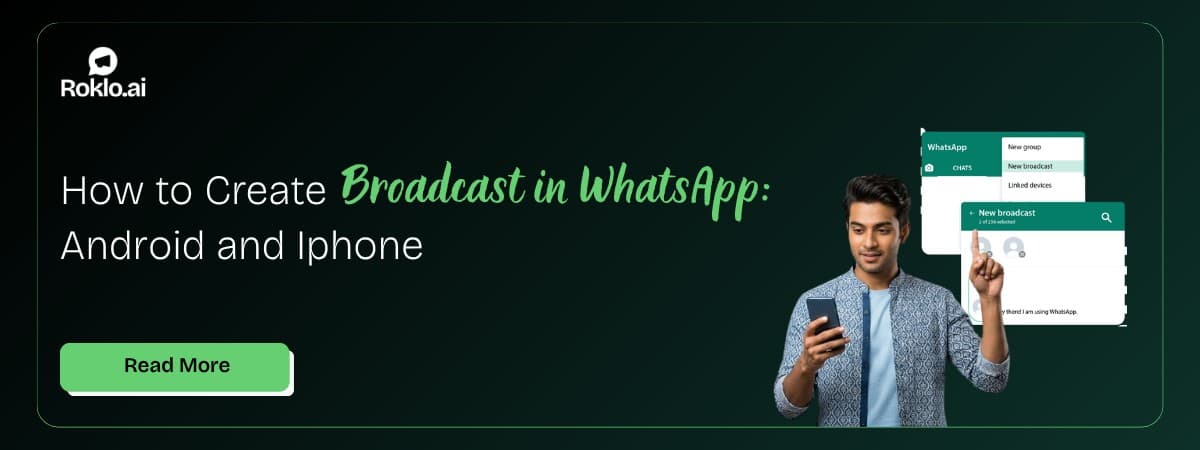
The WhatsApp broadcast list is WhatsApp's built-in feature for sending one message to multiple contacts as individual private chats. Each recipient receives the message as if you sent it directly to them. They do not see who else received it.
Critical limitation: Only contacts who have saved your number in their phone will receive the broadcast. If a contact has not saved your number, the message will not deliver to them at all. You will see it as sent on your end, but they receive nothing. For any list that includes leads, new enquiries, or contacts from a form, a significant portion will not receive the broadcast.In short: Broadcast list works for a small, warm, known audience where every contact has your number saved. For anything beyond that, the method fails silently.
The WhatsApp Business App gives you additional tools for managing customer conversations, but the bulk send limitations are identical to the standard app. The broadcast list is capped at 256 contacts with the same saved-number requirement.
Where the Business App genuinely helps with multiple contacts:
How to send bulk messages on WhatsApp Business using the broadcast list is the same process as the standard app. The Business App does not unlock higher contact limits or remove the saved-number requirement.
Also Read: WhatsApp Marketing for Ecommerce: The Complete 2026 Guide for Indian Stores
A browser-based bulk sender connects through your WhatsApp Web session via QR code. It is not a Chrome extension. It works in any browser. There is no API integration and no Meta verification required.
This is the method that removes both native limitations at once: no fixed contact cap and no saved-number requirement on the recipient side.
The key distinction: a browser-based tool uses WhatsApp's own infrastructure through WhatsApp Web. Your account stays connected because you are still using the official interface. WhatsApp's servers cannot distinguish between a human clicking through WhatsApp Web and a tool doing it at a controlled pace.
A comparison of browser-based bulk sender software options including Roklo, Sheetwa, and WASender covering features, safety ratings, and use cases is in the best WhatsApp sender tools in 2026 and why Roklo is the safest choice.
This process requires no API, no developer, and no Chrome extension. Any business can complete it in under 10 minutes.
Go to app.roklo.ai in your browser. Click Sync your WA in the bottom left corner. A QR code appears on screen. Open WhatsApp on your phone, go to Linked Devices, and tap Link a Device. Scan the QR code. Your WhatsApp session connects in under a minute.
You do not need to keep your phone active after this. The session runs through your browser independently.
For contacts already in your WhatsApp, they import automatically when you sync. For contacts not in your WhatsApp, click Import Excel on the Contacts dashboard. Your spreadsheet needs at minimum a phone number column with country code (+91 for India) and a name column for personalisation.
Result: your full contact list is visible in Roklo with name, phone number, and connection type.
Go to Groups in the left sidebar. Click Create Group. Add the contacts relevant to this campaign. Name the group clearly: Diwali Sale Customers, Coaching Parents Batch A, New Leads October.
Segmentation is not just organisation. A message sent to a relevant segment generates fewer spam reports and higher response rates than the same message sent to your entire list.
Go to Templates. Create a new template. Use {{name}} to open with the recipient's first name. Keep the message under 150 words. State the purpose in the first sentence. One clear action at the end. Include Reply STOP to unsubscribe on promotional messages.
A full library of ready-to-use message templates for every business scenario — promotions, order confirmations, appointment reminders, re-engagement — is in WhatsApp message templates for business.
Go to Campaigns. Click New Campaign. Select your template and your contact group. For a scheduled send, choose Schedule for Later and set your date and time. For an immediate send, choose Send Now.
Roklo's anti-ban engine spaces messages automatically between sends. You do not manage intervals manually. Your campaign delivers to the full selected audience with message pacing handled in the background.
For scheduling campaigns ahead of a sale, festival, or product launch and choosing the best send times by campaign type, the scheduling guide is in how to schedule WhatsApp messages for campaigns.
In short: Five steps: sync WhatsApp, import contacts, create a group, write a template, schedule the campaign. No API. No per-message fee. Roklo handles delivery pacing automatically.
Not all bulk WhatsApp message service tools are equal. Before choosing one, verify it has these features.
Also Read: 20+ WhatsApp Message Templates for Business (Free & Ready to Use)
WhatsApp does not publish a hard daily message limit. What it monitors is the pattern of activity, not the total number. An account that jumps from 10 messages per day to 800 overnight is flagged reliably. An account that reaches 800 through a four-week gradual increase is not.
Account History | Recommended Daily Volume | Key Guidance |
New number (under 1 month) | 50 to 100 messages per day | Start low. Build sending history before scaling. Do not spike. |
Established (1 to 6 months) | 200 to 500 messages per day | Increase in weekly steps. No daily jumps. |
Active (6 or more months) | 500 to 1,000 messages per day | Consistent patterns. Avoid sudden volume spikes. |
Account warm-up: If you are starting bulk sends on a number for the first time, begin at 50 to 100 messages per day for the first two weeks. Increase by 50 to 100 messages per week after that. Consistent daily sends at a lower volume build a stronger account history than occasional high-volume blasts.
Every specific trigger that causes WhatsApp account restrictions, including block rate thresholds, what happens after the first flag, and how to recover a restricted number, is covered in detail in how to send bulk WhatsApp messages without getting banned, which includes the warm-up schedule and the sending patterns that WhatsApp's system flags most reliably.
These templates are copy-paste ready for the most common bulk send scenarios. Replace items in {{brackets}} with your actual details.
Hi {{name}}, our [season] sale is live. [X]% off on [product/category]. Valid until [date]. Shop here: [link]Reply STOP to unsubscribe.Hi {{name}}, a reminder about your appointment with [business name] on [date] at [time]. Reply 1 to confirm or 2 to reschedule.Hi {{name}}, [product name] is now available. [One-line benefit]. Limited stock. Order here: [link]Reply STOP to unsubscribe.Hi {{name}}, it has been a while since your last [visit/order]. Here is [offer] to welcome you back, valid until [date]: [link]Reply STOP to opt out.Hi {{name}}, you are invited to [event name] on [date] at [time]. [One-line about the event]. Register here: [link]Reply STOP to unsubscribe.Real examples of how these templates perform across different industries, including which message types produce the highest response and conversion rates, are in WhatsApp marketing examples that actually work, covering flash sales, appointment reminders, coaching institutes, and travel agents.
Being honest about this boundary saves significant time and prevents businesses from building a workflow that breaks at the point of scale.
Honest note: Browser-based tools are the right starting point for most businesses. The API becomes the right upgrade when your volume, automation requirements, or customer journey complexity justifies the setup time and per-message cost.
Also Read: How to Create a WhatsApp Business Account: Complete Setup Guide (2026)
Every spam report from an unrecognised sender moves your account closer to a restriction. Your opted-in customers, active leads, and registered contacts are safe. Cold numbers from purchased lists or scraped directories are not. One verified real-world figure: a block rate above roughly 2 percent of sent messages flags the number.
Reply STOP to unsubscribe at the end of every promotional send. A contact who opts out is one fewer potential spam report. Over a campaign of 500 contacts, every opt-out that does not become a report extends the life of your account.
Duplicate sends to the same contact are one of the faster ways to accumulate spam reports. If a campaign did not get the response you expected, change the message before the next send. Do not resend the same template.
Check delivery rates in Roklo's Message Activity dashboard after each campaign. A drop compared to your previous campaigns, or a rise in non-delivery signals, means your account is being throttled. If you see this, reduce volume and pause for 48 hours before resuming. If messages are consistently not delivering, why WhatsApp messages are not being delivered covers every cause of delivery failure including the difference between a block, a restriction, and a saved-number issue.
Sending bulk WhatsApp messages without the API is practical and safe when done correctly. The WhatsApp broadcast list handles small, warm lists of under 256 contacts where every recipient has saved your number. A browser-based tool handles anything beyond that: larger lists, unsaved contacts, scheduled campaigns, and delivery tracking, without API approval or per-message charges.
The businesses that send bulk WhatsApp messages without account issues long-term are not the ones with the largest lists. They are the ones with the most relevant messages, the cleanest lists, and the most consistent sending behaviour.
Roklo is a free bulk message sender that handles contacts, groups, templates, scheduling, and delivery tracking from your browser. Scan the QR code, import your contacts, and your first campaign is live in minutes. No API. No per-message fee. No saved-contact requirement on the recipient's end.
Content Strategist at Roklo
Arjun is a content strategist with a passion for demystifying technology and helping businesses grow with smart digital solutions. At Roklo, he crafts in-depth guides, tutorials, and industry insights to empower readers and drive meaningful results. With a background in digital marketing and years of experience in content creation, Arjun specializes in SEO, branding, and SaaS. He believes in clear communication, practical advice, and staying ahead of the curve.